
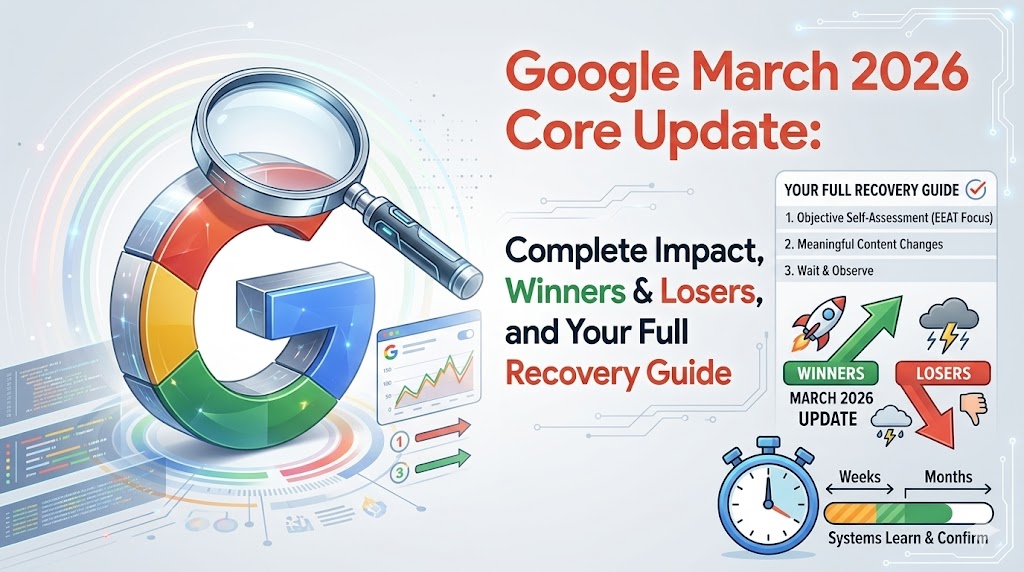
Google March 2026 Core Update
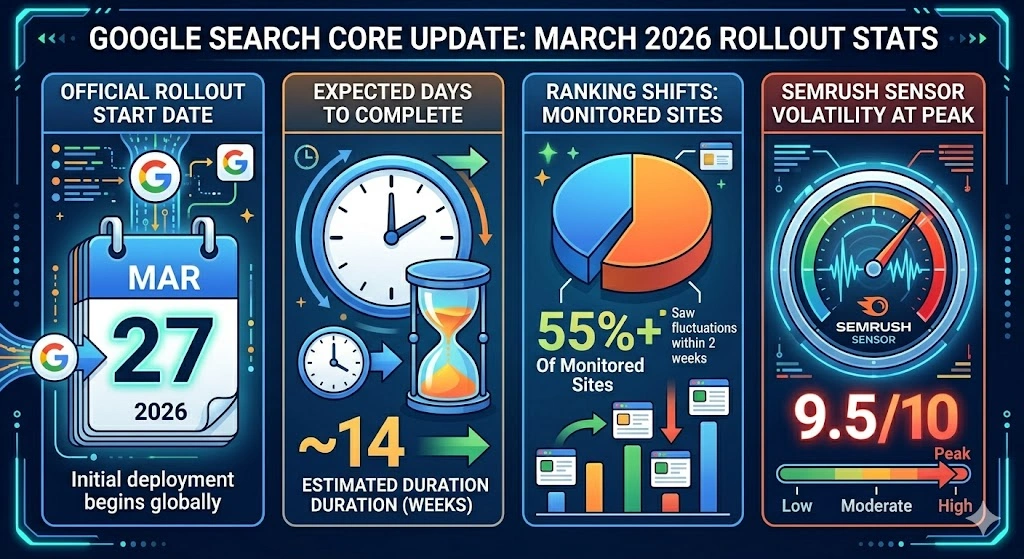
Google officially launched the Google March 2026 Core Update on March 27, 2026 — the first broad core update of the year and one of the most consequential algorithm shifts since the Helpful Content Updates of 2024. If your organic traffic has been fluctuating over the past 48 hours, this update is almost certainly the reason. This guide breaks down exactly what changed, who is winning and losing, and the precise steps you need to take right now to protect and recover your rankings.

Official Google Statement: “This is a regular update designed to better surface relevant, satisfying content for searchers from all types of sites. The rollout may take up to two weeks to complete.” — Google Search Status Dashboard, March 27, 2026
What Is the Google March 2026 Core Update and Why Does It Matter?
Core updates are broad, significant changes to Google’s ranking systems that happen several times a year. Unlike spam or product reviews updates, a core update does not target any single type of content or specific policy violation. Instead, it reassesses the overall quality and relevance of content across every industry and in every language globally.
The Google March 2026 Core Update is notable for two reasons. First, it arrives just days after Google completed the March 2026 Spam Update — making it the second major algorithm change in under a week. Second, it follows the February 2026 Discover Core Update, the first time Google ever publicly labeled a core update as Discover-only. Understanding the difference between these overlapping updates is essential before you begin any recovery work.
Google March 2026 Core Update: Key Fast Facts
How Is This Core Update Different from the February 2026 Discover Update?
The February 2026 Discover Core Update, which ran from February 5 to February 27, exclusively affected Google Discover feeds — it did not impact traditional Search rankings at all. The March 2026 Core Update, by contrast, is a full broad core update affecting all organic search rankings, all regions, and all languages simultaneously. If you noticed Discover traffic fluctuations in February, those were caused by the earlier update. Any organic search ranking changes from March 27 onward are attributed to this new core update.
Google March 2026 Spam Update vs. Core Update — Understanding Both
The March 2026 Spam Update targeted sites with clear policy violations — scaled AI spam, link manipulation, and thin doorway pages — and completed its rollout in under 20 hours on March 25. The Core Update that followed is not about spam. It is about relevance and quality. A site can be completely spam-free and still lose rankings in a core update if its content is not the most satisfying answer for the queries it targets.
Source: Google Search Status Dashboard / Search Engine Journal / Search Engine Land, March 2026
What Specifically Changed in the Google March 2026 Core Update?
Google did not publish a companion blog post outlining specific goals for this update. However, early analysis from the SEO community — combined with industry data from tools including SEMrush, Ahrefs, and Sistrix — has identified three major areas of change.
1. Information Gain Has Become a Primary Ranking Signal
The most significant shift in the Google March 2026 Core Update relates to a concept called Information Gain — a principle Google has referenced in research papers and holds a patent for. In practical terms, Google’s systems are now evaluating how much genuinely new, original information your content adds to the web compared to what already ranks in the top results.
Pages that simply reword existing top-10 content, aggregate well-known facts without original insight, or produce summaries without adding new data, perspectives, or first-hand analysis are losing ground fast. Sites with original research, proprietary data, expert interviews, and first-hand experience are gaining visibility. Early tracking data indicates that sites producing genuinely original work saw an average visibility gain of approximately 22% during the rollout period.
2. Google's Gemini 4.0 Semantic Filter Now Identifies Low-Quality AI Content
The Google March 2026 Core Update is widely considered to be the first core update to deploy Google’s Gemini 4.0 Semantic Filter at scale. This does not mean AI-assisted content is penalized outright. Google has been consistent on this point: it does not care whether content is written by a human or a machine, as long as it is helpful, accurate, and original.
What the Gemini 4.0 Semantic Filter does target is content produced at scale without meaningful editorial oversight — pages that read fluently and appear coherent but add nothing that cannot be found anywhere else on the web. If your site has been using AI to produce large volumes of content without genuine expert review, fact-checking, or original contribution, this update is a direct threat to your rankings.
What Does "AI Content Without Oversight" Mean in Practice?
Signs your content may be flagged by the new semantic filter include: no named author with verifiable credentials, no original data or citations beyond other web pages, content that mirrors the structure and arguments of existing top results, no demonstrated first-hand experience on topics where experience is expected, and excessive keyword density without contextual depth.
3. E-E-A-T Requirements Have Tightened — Especially for YMYL Topics
Experience, Expertise, Authoritativeness, and Trustworthiness (E-E-A-T) signals have been tightening with every major core update since 2022. The Google March 2026 Core Update raises the bar once again, with the sharpest effects on Your Money or Your Life (YMYL) topics — content about health, finance, legal advice, and safety.
According to research cited by Search Engine Journal, 72% of top-ranking pages now display detailed author credentials and demonstrable expertise, up from approximately 58% before this update. If you are publishing YMYL content without clear bylines, author biographies, professional credentials, or institutional affiliations, that is a significant vulnerability you need to address immediately.
Core Web Vitals Receive Increased Weighting in This Update
Technical performance is no longer a secondary ranking consideration — it is a primary one. The March 2026 Core Update reinforced Core Web Vitals as meaningful ranking signals. Three metrics carry the greatest weight:
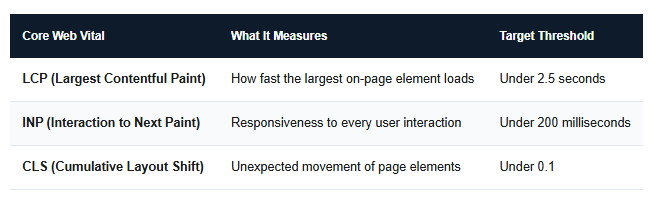
Data from Search Engine Journal indicates that 47% of sites with Core Web Vitals issues experienced ranking drops during this update rollout. Google’s systems now favor pages that load in under two seconds on mobile devices.
AI Search Visibility — The New Dimension of Ranking in 2026
Beyond traditional blue-link rankings, the Google March 2026 Core Update intensifies the importance of AI Overviews visibility. Google’s AI Overviews, which synthesize answers from across the web, are now appearing in a significant proportion of search results. Content that is well-structured, authoritative, and directly answers specific questions is being pulled into AI Overviews — generating impressions and clicks that do not show up in traditional ranking reports. Structured content with clear H1-to-H3 hierarchies, question-based headings, and direct opening answers is performing significantly better in AI extraction.
Data Sources: SEMrush Sensor, Search Engine Journal, Kahunam Analysis, BrightEdge AI Research — March 2026
How to Diagnose Whether the Google March 2026 Core Update Has Affected Your Site
Before taking any recovery action, you need an accurate diagnosis. Acting on instinct without data leads to unnecessary changes that can make things worse. Follow this structured diagnostic process.
Step 1 — Establish a Clear Baseline Using Google Analytics 4
Open Google Analytics 4 and compare your organic traffic for the two weeks prior to March 27 against the period beginning March 27. Focus on both total sessions and engaged sessions separately — sometimes overall traffic stays flat while engagement drops, which signals a query-type shift rather than a pure rankings loss. Segment by landing page to identify which specific pages were affected rather than viewing the site as a whole.
Step 2 — Use Google Search Console to Identify the Scope of Impact
In Google Search Console, navigate to the Performance report and filter by the date range from March 27 onward. Check for changes at three levels: the overall site, individual page clusters, and specific query groups. Also check the Discover tab separately — given the overlap between the February Discover update and the March Core Update, your Discover traffic may tell a completely different story from your organic search traffic. Do not conflate the two.
What to Look For in Your Search Console Data
Focus on pages where impressions are stable but clicks have dropped — this indicates you are still appearing in results but no longer in positions that drive clicks. Also look for pages where both impressions and clicks dropped simultaneously — this is a direct demotion signal. Pages where impressions increased but clicks dropped may indicate your content is appearing in AI Overviews but not receiving traditional clicks.
Step 3 — Run a Competitor Benchmarking Analysis
Use SEMrush or Sistrix to identify which competitors gained visibility in the same period your site lost it. Study the pages that moved up. What do they have in common? Look specifically for original data, named expert authors, more detailed topic coverage, better page speed scores, and stronger internal linking structures. These are your recovery signals.
Tools Recommended for Diagnosing Core Update Impact
- Google Search Console — impressions, clicks, query-level changes, Discover tab
- Google Analytics 4 — session quality, engaged session rates, landing page performance
- SEMrush Sensor — volatility tracking and competitor visibility changes
- Screaming Frog — technical crawl for thin content, duplicate pages, and speed issues
- PageSpeed Insights — Core Web Vitals scores per URL
How to Recover From the Google March 2026 Core Update — A Step-by-Step Action Plan
Google has been explicit over many years: there are no quick fixes for core update impact. A drop in rankings after a core update does not mean your pages have violated any policy. It means other pages are now being judged as more satisfying answers for those queries. Recovery requires genuine content improvement, not technical workarounds.
Strengthen Your E-E-A-T Signals Across Every Key Page
The single highest-impact action you can take following the Google March 2026 Core Update is improving E-E-A-T signals on your most important pages. This means adding detailed author biographies with verifiable credentials, linking authors to their professional profiles or published work, adding publication dates and last-reviewed dates, citing credible primary sources, and in the case of YMYL content, having content reviewed by qualified professionals before publishing.
Audit and Upgrade Underperforming Content for Information Gain
Conduct a page-level audit starting with the URLs that lost the most impressions since March 27. For each affected page, ask these questions: Does this page contain any information that cannot be found on the top-five competing pages? Does it include original data, unique expert commentary, or first-hand experience? Is the depth of coverage genuinely superior to what currently ranks? If the answer to all three is no, the page needs a substantive rewrite — not a cosmetic refresh, but a genuine upgrade in depth, originality, and expertise.
Prioritize Original Research and Proprietary Data Creation
The highest-value SEO asset in 2026 is original data. Conduct surveys, publish case studies, analyze proprietary datasets, or produce industry reports that no competitor can simply replicate. Pages anchored by original research that is cited by others are among the most stable assets in any Google core update environment — they satisfy the Information Gain signal directly and attract natural backlinks simultaneously.
Fix Core Web Vitals Issues on Every Page That Lost Rankings
Run every affected URL through PageSpeed Insights and Google Search Console’s Core Web Vitals report. Prioritize LCP improvements first — compress and properly size images, implement lazy loading, eliminate render-blocking resources, and ensure your hosting infrastructure delivers consistent sub-2.5-second load times on mobile. INP issues typically originate from heavy JavaScript execution; audit your third-party scripts and remove anything that is not essential to the user experience.
Restructure Content Architecture for AI Search Extraction
For content that is informational, restructure pages to maximize their probability of being cited in Google AI Overviews. Use a clear H1 that directly states the topic and includes the primary keyword. Open each major section with a direct, two-to-three sentence answer to the implicit question that heading poses. Avoid hiding information in accordions, tabs, or JavaScript-rendered elements — all visible content should be in plain HTML that Googlebot can read without executing scripts.
The Structural Pattern That Wins in AI Search and Traditional Rankings
The most effective content structure combines: a concise introductory answer in the first paragraph, followed by progressively deeper elaboration organized under descriptive headings, with factual claims backed by credible citations, original examples or data, and a clear conclusion that synthesizes the key insight. This pattern satisfies both traditional ranking requirements and AI extraction requirements simultaneously.
Recovery Timeline: Expect 4–8 Weeks Before Full Stabilization After Core Update Changes
Winners and Losers in the Google March 2026 Core Update — Industry Breakdown
| Sector | Typical Trend | Primary Reason |
|---|---|---|
| Niche expert publishers | ↑ Up ~22% | Strong E-E-A-T, original data, topical depth |
| Industry-specific B2B blogs | ↑ Up ~15% | First-hand case studies, expert authorship |
| Mass AI content farms | ↓ Down 30–40% | Gemini 4.0 Semantic Filter, no Information Gain |
| YMYL sites without credentials | ↓ Down 20–35% | Tightened E-E-A-T requirements for health, finance, law |
| News and original reporting | ↑ Stable to up | Freshness, authoritativeness, in-depth reporting |
| E-commerce category pages | ↓ Mixed | Thin product descriptions, poor Core Web Vitals on mobile |
What Google Says You Should Do If a Core Update Impacts Your Site
Google’s official guidance on core updates has remained consistent across all major releases. The key principles from Google’s Search Central documentation are worth reviewing in full each time a new update rolls out, because they address the most common misconceptions about what recovery actually requires.
There Are No Specific Technical Fixes That Guarantee Recovery
Google states explicitly that a negative rankings impact from a core update may not mean anything is technically wrong with your pages. Core updates are about relative quality — your pages may simply have been surpassed by pages that are now judged to be more satisfying. The path forward is content quality improvement, not a technical checklist.
Ask Yourself the Questions Google Uses to Evaluate Content Quality
Google’s documentation provides a self-assessment framework that mirrors its internal quality evaluation criteria. Ask yourself: Does the content provide original information, reporting, research, or analysis? Does it provide a substantial, complete, or comprehensive description of the topic? Does it provide insightful analysis or interesting information beyond the obvious? If a reader invested significant time in your content, would they feel they learned something valuable, or feel they needed to search again to find better information?
Monitoring the Rollout: When Will Rankings Stabilize?
Based on the pattern of recent core updates, the December 2025 Core Update took 18 days to complete. The March 2026 Core Update is expected to take up to 14 days. However, full ranking stabilization — where the new equilibrium settles in — typically takes an additional two to four weeks after Google confirms completion. Monitor the Google Search Status Dashboard for the official completion announcement before drawing final conclusions about your site’s new ranking position.
Final Words
The Google March 2026 Core Update sends a clear and consistent message: the sites that rank in 2026 are the ones that genuinely serve their users better than any competitor. Original content, demonstrated expertise, fast technical performance, and clear authorship signals are not optional extras — they are the foundation of durable organic visibility. If your site has been impacted, treat this as an opportunity to build the kind of content quality that survives not just this update but every update that follows. Audit your content for Information Gain, strengthen your E-E-A-T signals, fix your Core Web Vitals, and monitor your recovery through Google Search Console over the next four to eight weeks. The algorithm has changed — your content quality strategy must change with it.
About the Author
This article was written by Sandeep Kumar Rajput, Digital Marketing Manager with expertise in SEO and performance marketing. Insights are based on Google Search Central guidelines and industry research.
Last updated: March 28, 2026.